Sunday, February 16, 2014

Old Man


The “old man” of our carnal nature lurks ever vigilant.

Waiting patiently for the night of complacency to descend on our hearts and minds he is ready.

Possessing the power to escape we slowly become enthralled with the illusion of this life and turn our gaze.

Out of the mist of the forest he appears…


There's an old man living in the back of your woods tonight
You forgot he was even there, but you've never slipped his mind
He’s living off the scraps of you, you never knew you left behind
And as the sun goes down, he rises with a smile


He knows you have the answers, but Truth lies dusty on your shelf
And the sword that you could slay him with has become an ornament and nothing else
You could put him back down in his hole in the ground, but he knows you never will
He’s been around so long you got used to the smell

He knows Hell will never have your soul
But he will gladly rob you blind
While you're feasting at his table, he’ll tie your hands and numb your mind
He’ll take you farther than you wanna go
He’ll keep you longer than you wanna stay
And it will cost you more than you ever thought you'd pay


He’s waiting on the night to fall
The old man’s coming to call
You don't see the writing on the wall
He’ll never step out in the light
No, he’s just biding time
And while you slumber, he’s gonna come and take it all
He’s waiting on the night to fall
Casting Crowns

 
 O wretched man that I am!

How can I escape this old man that is taking me to my death?

Only by humble control by the Spirit.

Only by ceaseless immersion in the presence of God.

Only the naked soul in persistent prayer.


Romans 7 and 8

Saturday, February 1, 2014

Is war to freedom what oil is to water?


Oil. Water.

Freedom. War.

Some things just don’t go together. 

We don’t often think of this in relation to war and freedom but it is equally true. America has strong written rules regarding freedom of speech, assembly, rights to be heard by a judge/jury, protection against seizures without warrants etc. much of which has been enshrined in our Constitution. But what happens when we become embroiled in a conflict? How well do these freedoms mix with a state of war?

During the Civil War, Lincoln issued numerous executive orders and military regulations without the initial sanction of Congress. He declared martial law far from combat zones, seized property, suppressed newspapers, and suspended habeas corpus, all based under Article II of the Constitution. The Commander-in-Chief was well, commanding. He was acting according to his discretion all for the public good. Congress would often agree with him after the deed was done and the Supreme Court was  reluctant to disagree during the War. The times were desperate and people generally understood that things would go back to “normal” after the war and things did. 

The same basic events occurred in the subsequent major conflicts World War I and II.  Seizures of factories, mines, railroads, price restrictions as well as wartime restrictions on speech occurred. The order by Roosevelt, Executive Order # 9066, which cleared the way for the deportation of Japanese Americans to internment camps resulted in the now famous Supreme Court case Korematsu v. United States. The Court held that is was legal to do so.
We look back now aghast but it was really par for the course. Roosevelt at one moment of conflict with Congress said “In the event Congress should fail to act I shall accept responsibility and I will act.”  A Commander-in Chief with some fire in his belly. Right? After the war, things again largely went back to normal.

Let’s fast forward to the present. After America was attacked on September 11, 2001, Bush issued numerous executive orders relating to the deployment of military and security forces and the detention of captured terrorist suspects. We have stretched our normal understanding of and treatment of American citizens. We narrowed our definition of torture to allow for water boarding and we began to utilize our immense powers to spy even upon our own citizens which was activity only furthered by President Obama. Fourth Amendment violations? It’s war, nothing new to see here just move along. 

April 12, 1861- April 9, 1865.

December 7, 1941- September 2, 1945.

September 11, 2001-?

As we approach the thirteenth anniversary of the war on terror, now four years longer than any war we have fought previously no end is in sight. Civil liberties continue to be assaulted and I wonder how long till the oil of freedom becomes completely separated? Must we surrender our freedom in order to protect it? Who has won then?

To paraphrase Benjamin Franklin from long ago,
If a free people feel compelled to relinquish liberty for security they deserve neither and in the end—

will get neither.

Saturday, January 18, 2014

The Silence of God


It's enough to drive a man crazy; it'll break a man's faith
It's enough to make him wonder if he's ever been sane
When he's bleating for comfort from Thy staff and Thy rod
And the heaven's only answer is the silence of God

It'll shake a man's timbers when he loses his heart
When he has to remember what broke him apart
This yoke may be easy, but this burden is not
When the crying fields are frozen by the silence of God

And if a man has got to listen to the voices of the mob
Who are reeling in the throes of all the happiness they've got
When they tell you all their troubles have been nailed up to that cross
Then what about the times when even followers get lost?

There's a statue of Jesus on a monastery knoll
In the hills of Kentucky, all quiet and cold
And He's kneeling in the garden, as silent as a Stone
All His friends are sleeping and He's weeping all alone

And the man of all sorrows, he never forgot
What sorrow is carried by the hearts that he bought
So when the questions dissolve into the silence of God
The aching may remain, but the breaking does not
In the holy, lonesome echo of the silence of God


Written by Andrew Peterson; sung by Michael Card

Sunday, January 5, 2014

The Invisible Incorporation Doctrine


"That is a violation of my freedom of speech!! Haven't you heard of the First Amendment?!"

How many times have you heard such an exclamation from citizens?   But does the First Amendment really apply? Should it? Read the Bill of Rights. It begins with the words "Congress shall make no law..." and proceeds down the list. What about states? The way the Founders crafted the Constitution was to severely limit the federal government and to leave such things as freedom of speech to the governance of the states.
You see the states could in fact make laws that affected all the areas of the Bill of Rights. They, of course, believed firmly in such things as freedom of speech, freedom of religion, etc. This just gave "elbow" room to the various parts of our country. In different areas of the country, people could tailor their laws to suit their locale. Is this how things are today? The exclamation of the man on the street above is basically right. The Bill of Rights currently is mandated to all the states and uniformity is demanded. A conservative/liberal area of the country must have their laws reflect the law of the whole land. The Bill of Rights now almost entirely applies to the states.

What happened?

In the mid twentieth century the Supreme Court began to shift, one case at a time. They took the Fourteenth amendment (one of the post Civil War Amendments related to slavery and the treatment of blacks) and began to slowly tinker with it. By the present time, they have managed to twist the original meaning of the Fourteenth to usurp virtually all of the Bill of Rights and beyond. Now for example, abortion is allowable in all fifty states regardless of whether a conservative state thinks otherwise. All because of the new fourteenth amendment thinking. They call it the "incorporation doctrine." The slow, steady, and stealthy Supremes have managed to radically change the Constitution to the point that today the common man thinks it was always that way.

It wasn't.

Current Supreme Court Justice Antonin Scalia recognizes this usurpation but does not believe it is possible to undo it. Listen to his words from his book "Reading Law":

"We would...accept as settled law the incorporation doctrine---whereby the Bill of Rights is made applicable to the states...even though it is based on an interpretation of the Due Process Clause that the words will not bear."

Why?

Scalia answers, "Stare decisis--a doctrine whose function is to make us say that which is false under proper analysis must nonetheless be held to be true, all in the interest of stability. Courts cannot consider anew every previously decided question."

If the courts ignored precedent and flipped back and forth from session to session the public would lose confidence in them. The "currency" of the Court is confidence. The people believe by and large that when they speak it is the Constitution speaking. The Court knows this and guards it. It is not reality, of course. It is an illusion they must maintain, a consequence of their judicial interpretative method. I am reminded of a quote by Professor Frankfurter (later a Supreme Court Justice) in a letter to President Franklin Roosevelt in which he said, "People have been taught to believe that when the Supreme Court speaks it is not they who speak but the Constitution, whereas, of course...it is they who speak and not the Constitution."

I probably should, like Scalia, acquiesce to the invisible incorporation doctrine. 

I just can't.

#incorporationdoctine


Sunday, December 22, 2013

Ghost of Christmas Past


December 22, 1983.

Turning my memory toward the small town and the boys there the Ghost of Christmas past beckons me follow.

I recognize the streets. Cold rain from the night had frozen but I didn't notice. It was early in the morning and I had somewhere to go. I was starting down the two lane out of town and heading toward a sharp curve but why was the car in front of me going so slowly? Pulling out to pass quickly before the curve the other car suddenly speeds up, matching my speed. Is he trying to kill me?  My 1977 Mazda GLC strains but has nowhere near the power necessary for the task. I slam the brakes pulling behind the car. How could he do that?! I could have been killed! Anger instantly filling my mind I begin to chase the car. I WAS going to pass him. Turn after turn losing ground up the hills but making ground on the downside I pursue. Finally on a long downhill I slip beside the car and begin the pass.

Spinning, spinning. Darkness. Cold. Why am I lying in the grass? What are those people doing in the car? Warm blankets and pain. Writhing on the table my confused bruised mind is shallow. Why is Mr. West here? Saying nothing but grimacing and squeezing his hat.

The Ghost looks down the road. I know where he is going. Snowy hillside part way up just beyond the tree. I hesitate but cannot stop. Why are you tormenting me I scream in my mind! Now I want to stop but it’s too late. Pointing toward the grave marker this gray shadow looks at me. With deep heaviness I remember. I was not alone in the car that day. While anger was flowing through my veins sleep was covering my brothers’ outstretched limbs. Now sleep is all he knows.

On my knees crying out, “Dear God, forgive me!  Let me forgive myself! I have changed. Believe me, see me. I have changed. Anger rules me no more.”

Returning to the present, I see my children as they play.They are excited for Christmas so I stand and sing peacefully to them,

“Silent night, Holy night, all is calm, all is bright…”


“Be not quick in your spirit to become angry, for anger lodges in the bosom of fools.”


Ecclesiastes 7:9

Sunday, December 8, 2013

Tombstone Worthy


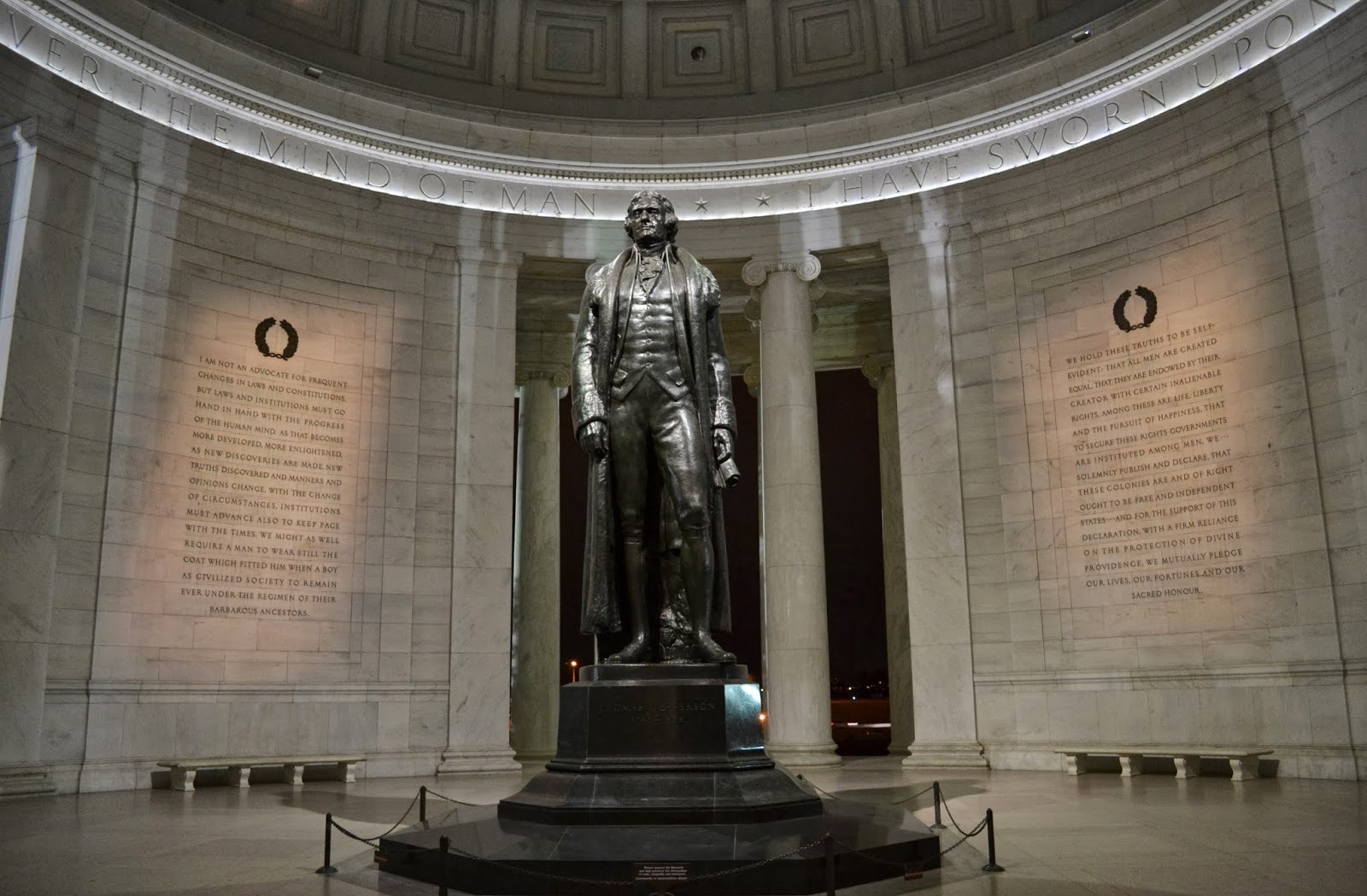
With the Supreme Court recently agreeing to hear a case addressing the free exercise of religion, Hobby Lobby (and Conestoga Wood) v Sebelius, I could not help but think back to Thomas Jefferson.


Before he died on July 4th 1826, exactly fifty years after the Declaration of Independence was written, he would direct only three things to be inscribed on his tombstone -- the creator of that very same Declaration, the founder of the University of Virginia, and the author of the Virginia Statute of Religious Freedom. Many Americans today would know the first, some know the second, but few know the last. No doubt more than a small number, who have visited Monticello and looked upon his grave marker, have thought, “No mention of President? What was that Virginia statute about?”

You see, Jefferson was a free thinker. Living in the waning days of authoritarian civil and religious authority, he was among those who would feel the wrath of nonconformity. Often accused of being an atheist or deist    
(charges that remarkably persist to this day), he was in fact neither. He lived a long life and his thoughts changed through the years as he searched for truth. Toward the end of his days, he anticipated his death and looked past it. On April 11th, 1823, writing to his old friend John Adams, he said, “I join you cordially and await his [God’s] time and will with more readiness than reluctance. May we meet there again, in Congress, with our ancient colleagues, and receive with them the seal of approbation, “Well done, good and faithful servants.” Jefferson repeatedly claimed to be a Christian, believed in the resurrection and looked forward to it. He, however, held what was and still are considered unorthodox even heretical views on various positions. He tried to keep these views secret as it caused him much grief whenever the public became aware of his real or perceived views.

Which brings me back to his tombstone and that law he helped create as a young man in Virginia. Being greatly concerned with obtaining the freedom of conscience, the freedom to think and believe and act on those without fear of retribution, he pressed hard for this law. This was not just a man-made temporary law. It was natural law. A God given law. Listen to the words Jefferson wrote as a 34 year old man in 1777. Words that he would carry with him to his grave:


An Act for establishing religious Freedom.


Whereas, Almighty God hath created the mind free;

That all attempts to influence it by temporal punishments or burdens, or by civil incapacitations tend only to beget habits of hypocrisy and meanness, and therefore are a departure from the plan of the holy author of our religion, who being Lord, both of body and mind yet chose not to propagate it by coercions on either, as was in his Almighty power to do.

That the impious presumption of legislators and rulers, civil as well as ecclesiastical, who, being themselves but fallible and uninspired men have assumed dominion over the faith of others, setting up their own opinions and modes of thinking as the only true and infallible, and as such endeavoring to impose them on others, hath established and maintained false religions over the greatest part of the world and through all time;

Be it enacted by General Assembly that no man shall be …enforced, restrained, molested, or burdened in his body or goods, nor shall otherwise suffer on account of his religious opinions or belief, but that all men shall be free to profess, and by argument to maintain, their opinions in matters of Religion, and that the same shall in no wise diminish, enlarge or affect their civil capacities. And though we well know that this Assembly elected by the people for the ordinary purposes of Legislation only, have no power to restrain the acts of succeeding Assemblies…yet we are free to declare, and do declare that the rights hereby asserted, are of the natural rights of mankind, and that if any act shall be hereafter passed to repeal the present or to narrow its operation, such act will be an infringement of a natural right.


Today, out of the thousands of letters he wrote, we remember only one of Jefferson’s quotes and it being misunderstood. The quote was from a letter to the Danbury Baptists in 1802, where Jefferson mentioned a “wall of separation of church and state”. We have forgotten the law he helped pass and had engraved on his tombstone.

The Supreme Court hears the latest assault on the freedom of religion next year. I wonder, will they be the succeeding assembly that declares this right null and void? If they do, like Jefferson I declare:

The rights hereby asserted, are of the natural rights of mankind, and that if any act shall be hereafter passed to repeal the present or to narrow its operation, such act will be an infringement of a natural right.”


A right, I must say, that is tombstone worthy.


#Thomas Jefferson #Hobby Lobby#religousfreedom

Sunday, December 1, 2013

Engraved with the point of a diamond


Long ago, in 587 BC, a man stood within the walls of a city that was being destroyed because it would not, could not do the right thing. He said with disgust, “From the least to the greatest, all are greedy for gain. 
All practice deceit. Sin…is written with a pen of iron, and with the point of a diamond: it is graven upon the table of their heart.” His name was Jeremiah.

Fast forward 2,588 years. Has man's basic nature changed?

 In 2001, a company called Enron became enveloped in a scandal that would lead to its demise. The greed and hubris of the executives was finally made known. The supposed watchdog, the auditing firm of Arthur Anderson, was also brought low due to their complicit activity in covering for Enron. In response, a number of laws were passed in an effort to prevent such behavior in the future. One of these changes was to require that certified public accountants, who perform the auditing, undergo proper moral training. It was thought that would prevent what occurred at Arthur Anderson.

Recently, I attended an all-day seminar covering a variety of relevant topics - taxes, rule changes, etc. Many were scrambling to complete their eight hours of required "continuing professional education" before the end of the year so as not to lose their license to practice. I attended with two colleagues. After a couple of hours, one leaned over to me and said, "I am going to step out for a bit. I’ll be back."

The clock ticked and hours went by. Finally, one hour before the end of the day he reappeared. “Had to make a couple long phone calls” he said. Interestingly, the final hour subject ? Ethics. The instructor spoke of right and left turns and of - well - just doing the right thing. My colleague leaned over toward the end and said, “This is all just common sense.” The final session ending he picked up his certificate reading, “Eight Hours of Continuing Professional Education Achieved.”

Smiling, he casually walked out of the hall.


“Sin…is written with a pen of iron, and with the point of a diamond: it is graven upon the table of their heart.”


Some things never change.